


CCI Accelerates Companies Solving Cybersecurity Challenges
Researchers Turned Entrepreneurs Learn How To Navigate the Marketplace
This month 13 teams pitched their research commercialization projects or companies to a panel of industry and venture capital experts. Photo by Jackie Tran for GMU.
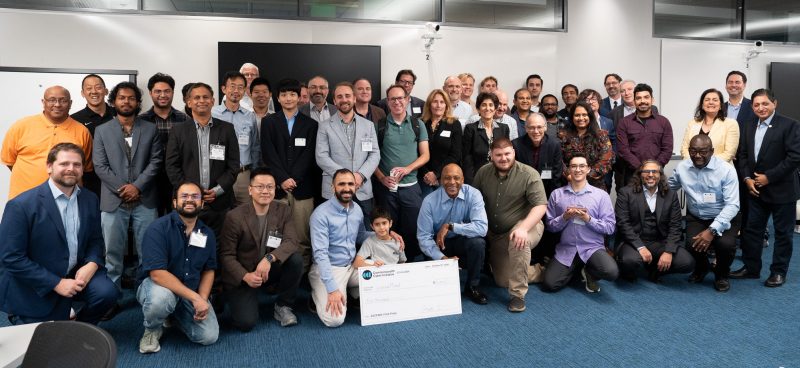
After five months of focused work, 13 teams pitched their research commercialization projects or companies to a panel of industry and venture capital experts on Oct. 15.
The CCI Accelerator is a commercialization program that’s helping teams identify the best pathways to bring their innovations from lab to market. Through the program, the teams could access expertise, connections, and hands-on guidance from 35 mentors, investors, CEOs, attorneys, industry leaders, and cybersecurity experts from across the D.C. region.
The program, supported by the CCI Northern Virginia Node and the CCI Hub, has two tracks: the CATAPULT Fund for teams emerging from Virginia public research universities, and the ASCEND Fund for startup teams working with faculty experts.
Both pitch winners are from George Mason University (interviews with winners below):
- CATAPULT: CyberMirage, a bot detection and mitigation tool designed to replace traditional CAPTCHAs.
- ASCEND: SecureMind, which creates a sealed chain of evidence for every decision an AI system makes, like an airplane’s black box.
The teams still have more work to do.
“Pitch Day is an important milestone, but only the beginning of the commercialization journey, and we look forward to supporting our teams as they take their next steps,” said Gisele Stolz, senior director, Entrepreneurship Programs at George Mason. She leads the accelerator program and won a CCI Impact Award for her work.
This year, the program created a “Spirit Award” to recognize teams whose engagement, commitment, responsiveness to feedback, and sustained effort stood out throughout the program, Stolz said. The Spirit winners plan to continue working with the program through opportunities such as National I-Corps, VIPC, and SBIR/STTR funding.
Spirit Award winners are:
- HGNsense (James Madison University) – is a pre-drive impairment detection technology designed to help commercial fleets verify driver readiness before a vehicle begins moving.
- Ahmad Salmon, associate professor, information technology, JMU
- Victor Escamilla and Ethan Johnson, entrepreneurial leads and JMU students
- RadLab (Virginia Commonwealth University) – combines AI coworkers and workspaces for cybersecurity work.
- Jake Olesen, assistant professor, digital forensics, VCU
- Justin Samson, DeepRunAI Labs
More to Come
CCI’s accelerator program plans to open a call for applications in early 2027.
“With outstanding cybersecurity research taking place at Virginia’s research universities, our mission is to translate that research into real-world impact and put Virginia on the national innovation map alongside ecosystems like Silicon Valley, Boston, and Austin,” Stolz said. “Our unique advantage lies in the broader D.C.–Maryland–Virginia ecosystem, where our partners’ expertise and networks help Virginia’s innovators compete nationally.”
Researchers come to the accelerator for different reasons, whether to sharpen a pitch, find funding, or test their research can solve a real problem, said Eta Nahapetian, CCI director of outreach.
“Some of the most valuable outcomes are the ones nobody plans for,” she said. “At pitch day, a startup founder I’d met earlier that day heard one of the teams present and immediately wanted to follow up. For anyone considering the program, that’s the real promise: Your work reaches people who can help carry it forward.”
Meet the Winners
ASCEND: SecureMind
Timothy Jones (left) of TBJ Investments presents Khaled Khasawneh of George Mason University with the $5,000 ASCEND pitch prize for SecureMind. Photo by Jackie Tran for GMU.
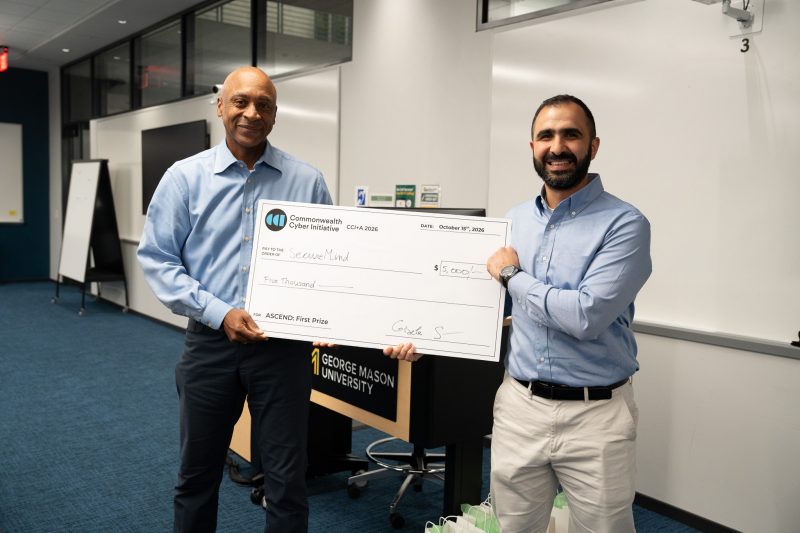
SecureMind creates a sealed chain of evidence for every decision an AI system makes, much like an airplane’s black box. Khaled Khasawneh, an associate professor of electrical and computer engineering at George Mason, leads the company.
Khasawneh applied because he wanted to know whether his research could make a difference beyond published papers. “The program gave us the structure and coaching to test whether our research ideas could become a product people would use,” he said.
The lesson that stuck with him came from customer interviews. “Real-world impact starts with listening, not with the technology,” Khasawneh said. “In research, we start from what is technically interesting and novel. Our customer interviews taught us to start from what the customer needs.” That shift changed how the team describes and builds its product.
The hardest part was learning to think like founders instead of researchers. That included explaining their work to funders or customers in five minutes while also juggling teaching, research, and family. “Every hour had to count,” he said.
His advice to researchers who are hesitating: “If you want your research to matter more, start by talking to 10 potential customers. You will quickly learn whether the problem is real, and either way it makes your research better.”
Next, SecureMind plans a six-month pilot with two or three design partners on one production AI model. The team is also pursuing non-dilutive funding, such as federal Small Business Innovation Research and Small Business Technology Transfer grants, to speed up development.
Learn more at securemindtech.ai.
CATAPULT: CyberMirage
John Funge (left) of Datatribe presents Mingkui Wei of George Mason University with the $5,000 CATAPUT pitch prize for CyberMirage. Photo by Jackie Tran for GMU.
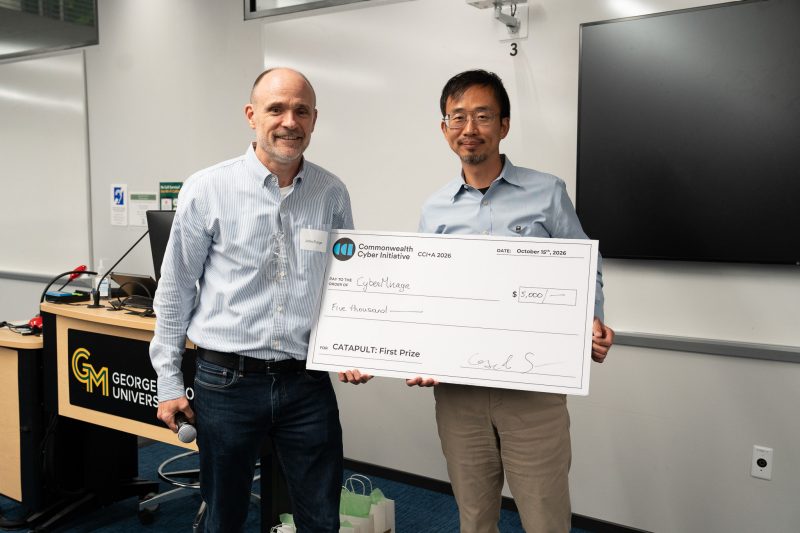
CyberMirage is a bot detection and mitigation tool designed to replace traditional CAPTCHAs. It is led by Mingkui Wei, an associate professor of cyber security engineering at George Mason.
Wei had been through the program before. He came back because he knew the support would help his company grow. The check-in sessions were the most valuable part, he said. In those sessions, mentors helped him reexamine the problem CyberMirage solves and sharpen his pitch.
The team’s biggest gap is on the business side. No one on the team currently handles business development, marketing, or sales, and Wei plans to bring someone on to fill that role soon.
For researchers on the fence, Wei said, “It is satisfying to see that your research outcomes are turned into a real product, which is recognized by real customers and is used to help them.”
The team’s next step is bringing more customers on board.